Leadership Is…

stretch
Leadership is stretching yourself and allowing others to grow. It is pushing yourself to continually learn more and step outside of your comfort zone. (cc licensed photo by http://www.flickr.com/photos/mikebaird/2910365807/)

boat

Leadership is not accepting the status quo, and sometimes taking some heat for that. Sometimes, standing up for what is right entails taking risks. (cc licensed photo by http://www.flickr.com/photos/markwoodland/4524170205/)

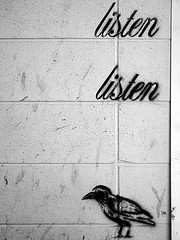
listen
Leadership is not about telling others what to do. It’s  about asking questions, listening, and empowering those around you to take the lead. Great leaders help others move forward. (cc licensed photo http://www.flickr.com/photos/striatic/133146861/)

How have you grown? How have you helped others to grow?

When was the last time you “rocked the boat?”

How are you helping others to take those steps forward?

This Is A LEARNING Class

Numerous times throughout my teaching career, I have had students ask me something along the lines of… “Why are we talking about science/English/social studies stuff in here? This is MUSIC class.” I almost always respond, “No, this is a LEARNING class. Besides, it’s all connected anyway, right?”

Why anyone decided that it would be best to teach kids to learn subjects in isolation is beyond me. When my oldest daughter was a freshman in high school, her freshman history teacher told me at parent/teacher conferences that he was amazed at how well my daughter was able to make connections. He explained that, when they discussed a certain topic in class, she was able to quickly draw an example from a seemingly unrelated event and make comparisons. He said that the majority of freshmen in his classes were nowhere near to having that ability.

This is the same child that struggled miserably on standardized tests, yet still did very well in school. Would you be surprised, however, to learn that she is very gifted in music and has been surrounded by music and  musicians her entire life? When she was in Kindergarten, she came home singing the Queen of the Night’s Aria from Mozart’s The Magic Flute.  She then explained the entire plot to me, from her 5 year old perspective and then told me how much it was like a story she had read about people falling in love. What??? And she was actually spot on.

Okay, so this post didn’t start out to be a synopsis of how brilliant my child is. She is brilliant, but that’s another story. (ahem, proud mom)

I don’t think it’s any coincidence that she is able to make connections so easily. She was introduced to the piano literally days after birth. As a toddler, she sang along with the voice students who used to come to our home on Saturday mornings. We played every type of music for her- classical, pop, jazz, country, rock. She began dancing at the age of 3. To say that music was a huge part of her life would be a gigantic understatement. We talked all the time about music – what the music was about, where it came from, etc. I could cite research about how music helps brains to for connections, but that’s really not where I’m going with this.

Back to the classroom examples: in my classes, if we learn a new song, we learn about the song’s origins. Where did it come from? What language is this? How do we sing it in this language? Why was it written? What is the subject? If it’s about butterflies, let’s talk about the life cycle of butterflies. Can we find someone to Skype with us about this song? Let’s write our OWN song about butterflies. What should that sound like? Through the music, we can see that LEARNING isn’t reserved for those topics listed in the syllabus or title of the class.

In my classroom, I have the luxury of no state testing for which to prepare my students. We don’t have to practice for tests. We get to spend more time learning about our world and how connected we really are. When you give children the tools to help them see connections for the first time, they get better and better in making connections on their own. They realize we are not the only ones on this planet– and though we have differences, we also have a lot in common with other people around the world. Our music might be different-sounding than the music in Ghana or Tibet or Indonesia or Iceland… but it’s still music. It is still created by people about themselves and their surroundings.

My job is to teach children to LEARN. The fact that I do that job in a music classroom is secondary to that at all times. And yes… I am lucky that I have the opportunity to use music as the tool to make those connections.

A Balancing Act

A year ago last January, I wrote a post on “Balanced Connections.” At the time, there were a lot of people talking about how our children don’t spend enough time away from the computer or TV or video games. I’m one that definitely agrees kids need to have some offline time.

Balance

Balance

More recently, my own family has mentioned to me that maybe I’m online too much. There are times when it’s difficult to put down the Blackberry or step away from my laptop, because there are SO many great ideas flowing with people in my network. At times, it’s difficult for my family to understand that I’m working… not just chatting with my friends. I do agree, however, that guidelines must be in place about when it’s appropriate to bury your face in your Blackberry. Dinner time with the family is definitely not that time.

Today, I read an OpEd article in the NY Times, “Tweet Less, Kiss More.” The opinion is that we need to spend more face-to-face time and not bury ourselves too much into technology. I agree. I definitely take time off the grid, so to speak, to read, spend time with the family, and participate in activities that are no-tech or low-tech.

Friday, I caught an episode of House, M.D. right after eating dinner. I don’t watch too many TV shows regularly, but it was on (and I  love Hugh Laurie) and this episode really grabbed my attention early. The short version of the plot: a woman blogs about everything in her life… contracts some mystery ailment, and House and crew have to solve the puzzle to save her life.  While they are contemplating her symptoms, the doctors are scratching their heads, asking themselves why anyone would be so public with their lives- where’s the privacy? Why would you want to blog literally about every activity in your life? Then Peter Jacobson’s character, Dr. Chris Taub makes a statement that privacy is actually not the norm… it’s a relatively  “new” concept. For centuries, people lived in small villages and everyone always knew each other’s business. Privacy is more of a 19th-20th century invention.

At that point, my brain went, “AHA!” He’s right. One of the biggest complaints I hear from people who do not have an online presence is that sharing information about oneself online is an  invasion of privacy and why would we want to share every facet of our lives with people we don’t really know? In the House episode, the patient/blogger maintains that she DOES know the people she communicates with online. Just because she’s never met them in person doesn’t mean they don’t have meaningful relationships. And… I agree with her, too.

How can I agree with the “Tweet Less, Kiss More” writer AND with the blogger in the House episode at the same time?

It has to be about BALANCE.

When we hear people talking about kids needing balance, they are usually referring to more OFFline time. A lot of educators who don’t spend time online are the biggest proponents for kids needing more offline time.

BUT… how many of our educators really have that balance they want for kids? I’m wondering if enough of them actually spend enough time online?? Is there value in having an online presence? Yes. Can you still have a life outside of Twitter and blogs and wikis and Flickr and…  YES. You have to have those guidelines that I mentioned above, but it’s definitely possible.

If you don’t spend enough time online, though, can you achieve the same balance you’re recommending for kids? I don’t think you can.

I Am A Teacher

I am a teacher. By choice. Why? Because I love learning more than little kids love candy… and helping others learn makes me incredibly happy. teach_inspire

Too altruistic? Too sappy? Sorry, but it’s the truth, and it’s been that way since I was in 2nd grade. At the age of 8, I knew I wanted to be a teacher.

(This is another one of those posts I had to start and then put away for a little while. Too much emotion to write rationally. Reader, beware.)

There have been several articles I’ve read recently about education- education reform, how to improve schools, public vs. private vs. charters…. and so many of these articles include a perception of teachers that really scares me. And angers me. And frustrates me.

Perhaps no article I’ve read all year has provoked as many feelings as this one- Saving Oregon Schools: Targeting the wrong areas for budget cuts. Actually, the article on its own was not really the issue- I don’t agree with all the suggestions the author contributes (especially cutting extracurriculars), but the comments attached to that article? Wow. I know that comments sections are not always a true gauge of how people feel. Comments can provide an arena for flame wars to begin– the anonymity allows some people to go a little overboard. Par for the course, right?

Many of the comments to this article attack the Oregon retirement system for educators. There are many who believe teachers should not be allowed to retire with as many benefits as they do. I’m not writing this specific post to argue that point one way or the other. Teaching is a profession, where in most states, you are required to continuous professional development and graduate classes, advanced degrees… essentially life-long learning and full-time service to children throughout your career… but I’m not going to open that topic for this blog post.

Instead, it’s the perception of teachers that pervades many of the comments that has me so upset. If you don’t take the time to read any of them, let me just provide a few excerpts here. I’m not going to list the names of the commenters- feel free to go back here to read them yourself, if you wish.

“If you cannot do, teach! That’s so true. The smartest students in college go for real jobs, and the incapable became teachers. Right now there is an over-supply of new teachers. Why? Because these people were laid off and couldn’t land other jobs! These low-ability people shouldn’t earn this much of my tax money! Cut teachers first before cutting other resources.”

“This has been a problem for far too long and we’ve allowed the tax eaters, that is, teachers unions, to fleece the American public into thinking that more spending, which ultimately ends up in their members’ pockets, somehow equates to better outcomes.”

“I don’t think teachers pay is the issue, it’s the value we receive as a community supporting our public schools. We don’t receive “value” from what we spend our education dollars on. For what we invest in our Public Schools all of our Teachers and Administrators should hold Doctorates, work 20 hour days and graduate 99% of their students, who should easily ace there [sic] SAT Test.”

“I Hate to Say This, But Califonia [sic] found the Answer! The Governor rolled back Salaries to Minimum Wage Levels for all State Employees!!! What a Great Idea!!! In Oregon, that would mean No Lay-Offs and we could fund PERS…. Now That’s a Win, Win, for the State!!! Come on Ted, Let Get With the Program!!!!!!”

I don’t even know how to respond to these comments. I’ve battled the “those who can, do” statement for years, along with people outside of education who think I have my summers “off.” Teaching, apparently, is not a real job.

The teachers I know spend their summers attending more classes, workshops, and conferences to help them grow as teachers and learners- usually all summer. Additionally, they work extra jobs to help pay for tuition, they teach and/or tutor in summer programs, private schools and/or studios. The only time I can remember having a true summer vacation is when I worked in a corporate job and could take two weeks off without any other obligations.

There were several other commenters who railed against teachers’ unions that protect tenure and incompetent teachers. Are the unions really to blame? or is an inadequate evaluation system more the problem? Personally, I know a few teachers who have been dismissed for incompetence. It probably doesn’t happen as often as it should, but it does happen.

I didn’t write this post thinking I would be arguing with these comments. Instead, I had hoped to outline a bigger problem which is the perception of teachers. How do we as educators change the public view of what we do in the classroom?

If we leave it to outsiders, we’re not going to get anywhere. We have to be more proactive. We have to take action ourselves. I’m tired of hearing the negative stories in the media about the bad things happening in school and with kids. I want the media to see me- to see other teachers like me- to learn about all the amazing things happening in our schools!

My action plan is not that complicated:

  1. Contact the media more often. Invite them to my classroom (again). Share, through multiple methods, what it is we’re doing.
  2. Bring parents into the classroom more. The parents in my school are already welcome in my classroom, although not many of them take our offer to visit. I want them to share their expertise in my classroom more often. Side note- I actually have really great and appreciative parents in my school, and for that, I am extremely grateful.
  3. Bring more attention to other teachers and students who are doing great things. Not every teacher has a powerful network where he/she can share successes. I have a great learning network of people who love to share ideas, collaborate, and celebrate with each other.

I am a teacher. By choice. Not because I was incapable of doing anything else, but because I couldn’t imagine doing anything else that would make me as happy as teaching does. I forgot that for a while. I left the classroom for “bigger and better” things. Corporate jobs. Bigger paychecks. More prestige. I was really successful… and really unhappy. Now I’m a teacher again. A really happy teacher who needs to help others see the real reasons why we teach.

What are YOU doing that allows your community to know about great things in your schools?

[Photo credit: Teach & Inspire, taken by Ryan Hyde on April 17, 2010. RLHyde’s Photostream.]

Fly On The Wall

I started to write this post while I was attending ISTE 10, but wanted a little more time to think and reflect before finishing the final draft.

In several sessions, both formal and informal, there was discussion about how to participate in discussions at ISTE. Some people felt compelled to join the discussion instantly. Others hung back and listened. While some stated they were too new to the conference to contribute to a discussion, others noted that they learn a lot by simply listening.  I’m not a shy person, and I always have something to say… so I tend to encourage people to speak up, whether they’re newbies or not.

I have to admit though, that there is definite value in lurking and listening… whether it’s a face-to-face discussion group or an online conversation or chat. Isn’t that something I address often in my classroom? We have two ears and one mouth. Shouldn’t we listen twice as much as we talk?

My new friend, Nicholas Provenzano, aka @thenerdyteacher, brought up this point while we were sitting in the Bloggers’ Cafe at ISTE. He said something about how valuable it would be to become a fly on the wall at every part of the conference. That one reference set off a spark in my brain. For a person who has an opinion about everything, I can safely say it’s difficult for me to listen more than I speak. However, I’ve been trying to lurk more lately. It’s nice to try something different, and I’m definitely learning in a different way.

One thing I tried this year at ISTE that was different than past conferences was to participate in the backchannel in two sessions as an informal moderator. In addition to listening to the presenters, it was also an amazing experience to “listen” to the people in the backchannel. I thought I would be more distracted by others, but I found that I was actually more involved in the sessions.

Wow. This listening thing might become a habit for me.

Back to Reality

I’m still pondering the next few posts I’ll write about my experiences at ISTE 2010. Right now, however, I’m simply a little sad. It’s difficult to say goodbye (for now) to old friends and new friends… but I believe that the most difficult part of leaving a conference like ISTE is heading back to reality.

Let me explain: while I miss my family and home like crazy, and I’m really excited to start the school year and see my students again, it’s difficult to return from a place where people “get” you.  At ISTE, if you tell someone you’re on Twitter, they don’t look at you like you’re a crazed Ashton Kutcher fan who lives in a fantasy online world. When you discuss the inanity of standardized testing our children to a learning-coma-like state, they understand. It’s nice to be around people who know that using technology tools to help transform student learning means more than copying your paper notes to a PowerPoint slide. Or worse, PowerPoint slides.

I’m not saying that I’m an edu-snob or that I subscribe to the Nick Burns, Computer Guy mentality of tech support. I truly enjoy working with people who want to learn more about, well… about anything. Learning is always the key. But for one brief moment at the end of June each year, it’s really refreshing to be around some of my favorite people in the world. Luckily, I only have to wait about 360-ish more days until the next time.

Thanks, ISTE, for another great experience.