header image

Archive for 21st Century Learners

Balanced Connections

Posted by: Michelle Baldwin | January 19, 2009 | 3 Comments |

The term “social media” (or “social networking”) has always bothered me for some reason… but until recently, I didn’t truly understand why.

I’ve done several presentations about web 2.0, the changed nature of the internet, and what all that interaction really means to us. Often, I’ll hear from several adults, especially those who do not use web 2.0 tools, about their concerns regarding face-to-face time. Their concerns are that kids spend too much time plugged in and not enough time learning how to interact with people in person. They don’t think that ’social networking’ actually promotes anything truly social.

Because I came to be a web 2.0 user as an adult with what I would consider fully developed social skills, I can’t really speak from my own experience. Or can I?

I don’t really have problems interacting with people in person. Although painfully shy as a child, I learned strategies to overcome my shyness so that I could interact with others. I use those strategies every day.

When I started blogging, chatting, texting, IM’ing, Tweeting (verb for using Twitter), Second Life-ing, [insert additional web 2.0 tools here], I wondered if all of that ‘plugged in’ activity would change my social interactions. I have to say… IT DID. But here’s the surprise: I honestly think it changed everything for the better. And here’s how:

  1. When I met other ed tech people online through their blogs or via Twitter, for example, those online connections made it easier meeting them eventually face-to-face at a school or conference. We already knew we had something in common. Our previous online experiences became our ice breakers. We could get past the early (sometimes awkward) small talk that inevitably occurs when you first meet someone, and move to what we really wanted to discuss. [Image credit:pengo-au]1
  2. With people I already know, it’s difficult to maintain connections in our extremely fast-paced lives. In addition to our jobs and families, there are so many other obligations. I feel like I don’t always have time to make a phone call or pay someone a visit… especially if they don’t live in the same area. Online opportunities like Facebook have provided a quick place to catch up, share photos and videos, chat, and more. Does it replace the face-to-face I wish I had with my friends and family? Not all the time. Sometimes, however, it does provide a more timely connection than I would have with those people if I waited for the face-to-face time. Plus, I know more about some of my college friends and their families now than I ever did before. In more cases, I’d lost track of some friends who eventually found me on Facebook. I can honestly say that social networking has really enriched some of those relationships.
  3. My kids use social media. There are MANY times when Facebook, texting, or IM have taken the place of the reminder note on the refrigerator. I KNOW they check those online tools daily. Our communication has definitely improved because of these tools, AND sometimes it encourages new face-to-face discussions. All of my children have endured several conversations with me that start out, “So tell me what you meant by your Facebook status/comment/post today.” They don’t always like it, but it definitely beats the worn-out “how was your day, dear?” usual fare. Our conversational topics encompass school, friends, dating, driving… you name it. If it’s on their Facebook (or glaringly omitted), it’s open season for discussion.

In my opinion, It all comes down to balance. I do not spend all my waking hours online. I set boundaries for my kids about their online time. If a conversation can happen face-to-face, that’s encouraged. If it’s an emotional issue or serious situation, we discuss that face-to-face. [Image credit: dirkjanranzijn]2

And for those people who are concerned that our kids will turn into texting, posting, chatting machines who are completely bereft of social skills… I think you need to dig a little more deeply into what kids are actually doing online. Learn more. Try it yourself. You may be surprised how much better YOUR OWN communication can be, as long as balance is a consideration.

Oh, and don’t just take my word for it. Here’s an article in Time’s online magazine that I found today before posting.

1pengo-au. “PV Connectors.” pengo-au’s photostream.6 Nov 2008. 19 Jan 2009. http://flickr.com/photos/pengo-au/3018725308/
2dirkjanranzijn. “Balance.” dirkjanranzijn’s photostream. 17 Jul 2008. 19 Jan 2009. http://flickr.com/photos/dirkscircusimages/2676182569/

under: 21st Century Learners
Tags: , , , , , ,

Where Do You Stand

Posted by: Michelle Baldwin | January 12, 2009 | 3 Comments |

January Think-About

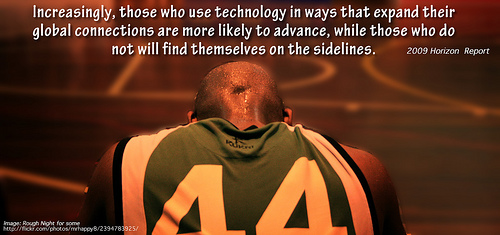
Scott McLeod posted this photo back in October. I’m using it as a discussion point in some sessions this month.

Answer these questions:

1. What are your initial feelings/thoughts after viewing this photo and quote?

2. What are you doing to change that perception in education?

If you have a response on another site- photo, quote, blog post, or otherwise- please include a link in your comment.

under: 21st Century Learners, Monthly Think-About
Tags: , ,

Time Is What You Make Of It

Posted by: Michelle Baldwin | December 10, 2008 | 6 Comments |

December Think-About:

I’m often asked about the issue of “time”- usually during presentations/workshops about anything associated with blogging, wikis, microblogs, shared bookmarks, RSS feeds, etc.

“Who has the time to do this?”
“Why would I ever want to do any of those things? Where would I find the time?”

“All those things are great, but I have a life. There just isn’t time
to do it all!”

As a rule, I usually note during those sessions that I don’t sit behind a computer 24/7/365. BUT… I wonder if the participants really believe me? My guess is that many don’t believe me (I’m a ‘techie,’ right?), or they assume that the nature of my job affords me more time to read blogs, share on Twitter, add shared bookmarks, and post to my own blogs every single day.

The fact is… my job doesn’t really afford me more time to do any of these things. Instead, I’ve made the decision that using those tools help me to grow as a professional. I’m connected to people all around the world who are willing to share their ideas with me, collaborate with me on projects and ideas, and learn with me about preparing 21st century learners for future success. Why would I NOT make time for that?

We know that young people are also using these tools and gaining extraordinary benefits- when the tools are used appropriately. Perhaps that fact alone would be the motivating factor for making time.

I’ve always been told that you make time for those things in your life that are your priorities. So… why should this be a priority?

  1. If you’re preparing students to be successful for the future, you need to understand the learning tools they have at their disposal. We all understand best by DOING.
  2. These tools should be used in schools. Period.
  3. You will see a substantial increase in your own personal growth. I learn every single day from someone who shares with me. If you follow others in your field who are positive, strategic, and visionary, it’s nearly impossible to find these experiences unworthy of your time.

Here is a sampling of some “web 2.0″ tools I use- those that I use most often:

I don’t use every tool every day, nor did I try to take on all of them at one time when I first started. In each case, I found a tool, tried it for a while, then decided if it provided me any advantage or benefit. What I found was that each one serves a different purpose, and I go to them for very different reasons. Of course, there were some that I found weren’t useful to me, so I don’t use them. In some cases, especially communication, I’ve found these tools actually save me time!

Because I’m seeking balance in my life, I’m also very deliberate about how much time I spend using these tools when home. That tends to be more difficult, but it’s important to make my family time a priority, too.

Just like we all need to find  time for recreation, for exercise, for learning, for SLEEP… I think it’s also possible to find time to blog, or contribute to a wiki, or share with others in your field through some other  web 2.0 tool. Maybe it’s once a week or once a month, but the time is there if you make it.

Is it a priority for you?

under: 21st Century Learners, Monthly Think-About
Tags: , , ,

I am always extremely encouraged when I hear about teachers who incorporate blogging as a tool for students to reflect and evaluate. There are some really great classroom blogs where teachers have provided some guidelines about blogging and expectations for their students. One good example of a classroom blog is the South Titan Government Blog. Read the posts, but also read the guidelines from the teacher on the side.

Unlike the above example, I have found that some teachers assume students already know “how to blog” and, therefore, do not provide any structure. In most cases, these are classrooms where the teacher is not a blogger and is simply unaware that students need some specifics about blogging topics, expectations, and even etiquette.

There is a big difference between knowing what a blog is and blogging with a purpose.

Here are a few tips and resources for being planful with your students in class blogs:

1. If you are an educator who does not blog, be sure to read some education blogs* first.

  • You need to understand a little bit about the nature of blogs yourself before opening them up to your students.
  • Feeling confident? Start your own edublog!

*Not sure where to go to find edubloggers? Try Jolene Anzalone’s “Blogs in the Classroom” page. Also, check the blogroll on the right side of this page. When you jump to another blog, view that edublogger’s blogroll, too. OR– use a search engine to find blogs about education.

2. Provide guidelines. Discuss digital citizenship and responsible, constructive blog posts and comments. Check out this network for discussion about digital citizenship by kids: http://digiteen.ning.com.

3. Classroom vs. Individual Blogs: Make the decision about having a classroom blog (one blog with many contributors), or each student create his/her own blog. If your school subscribes to a service such as Gaggle, students can blog within their own accounts in a safe environment.

4. Encourage constructive commenting. Remember the advantage of blogs vs. journals on paper is the instant feedback option.

  • Students think more about their writing when they understand it will be read by more than just the teacher.
  • If their classmates are reading and providing comments as well, students tend to think differently about what they write.
  • Empower your class by allowing them to comment on each others’ blog posts. With appropriate guidance, students can help each other grow as writers by commenting constructively.

5. Start with something simple. Try any of these suggestions… they may be used in any subject/content area:

  • If you’re not quite ready to turn over blogging to your students, start a teacher blog and allow students to comment on your blog posts. After you’re all comfortable with the functionality of a blog, you might consider a classroom blog or allowing students to have their own blogs.
  • Provide your students a writing prompt for a blog post.
  • Ask your students for a reaction to a class activity. What did they like most? What would they have changed about the activity? What did they learn from the activity? How could they learn more? (this could easily tie into using a graphic organizer for K-W-L-H activities, with the L and H sections added to the blog post!)
  • Students can post blog entries about an assigned reading. If you already have your students journaling about assigned readings, adapt the journal activities/assignment for blog posts instead. Again, encourage students to read their classmates’ blog posts and comment constructively.
  • Ask your students to debate one side of an issue as a blog post. They should include justification for their stance on this issue.
  • Within students blogs, start a “Good Questions” category or tag for blog posts. When you ask students to think about good questions for a specific lesson or unit, they can enter these questions as a blog post and tag or categorize them as “Good Questions” for easy access later.
  • Use a classroom blog for virtual trips and journal entries. Take your students around the world and then ask them to generate a class post about their experiences.

There are endless possibilities to how you might use blogging with your students. What is most important, however, is the impact on student engagement that good blogs can provide. Again, with proper structure and teacher guidance, blogging can add to a teacher’s ‘tool box’ for good instruction and learning opportunities.

Looking for some more resources and examples? Try these:

Using Blogs to Promote Authentic Learning in the Classroom – guidelines, help, more resources, blog examples

Collaboration Nation- A Middle School Blog – middle school blog from a Connecticut school

Rach’s Blog – a blog by a student from Australia

Mr. Klein’s 5th Grade Blog – classroom blog from Plainfield, IN, US

Creative Writing Chronicles – a literary journal from Stratford High School

Primary 5 L/W Class Blog – a primary class blog from Carronshore, Falkirk, Scotland

Stretton Handley Primary School Blog – a year 6 class from Derbyshire, UK

under: 21st Century Learners, Blogging
Tags: , , ,

Accentuate the Tech Positive

Posted by: Michelle Baldwin | November 11, 2008 | 1 Comment |

Techno-fear: a state where humans feel they are losing control due to advances in technology.*

Nearly every day, I’m bombarded by statements – in person or via some news outlet- expressing “techno-fear.” If a young person is in trouble due to something posted to a social network, there is a negative focus on the public nature of the social network. If an adult is fired due to inappropriate photos posted on the web, technology is to blame.

When I begin presentations on web 2.0, usually there is a least one person rolling his eyes or shaking her head when I start to talk about social networks and multi-user virtual environments (MUVEs). The audience assumes I’m going to talk about the dangers of these web environments.

Instead, the focus should be how these tools are used positively, how they can elevate thinking, and how they engage users. We can also discuss privacy and web permanence… but those don’t have to be scary topics.

How could we all approach these ideas positively with kids?

5 quick starts:

  1. Begin by exploring social networks and MUVEs for yourself. If you don’t understand these environments, you can’t speak the language… nor can you make any accurate judgments about their usefulness. (Darren Draper wrote a great blog post today about “immersion.”)
  2. Start genuinely talking to kids and asking them what they do online. Be open-minded and really LISTEN.
  3. Take note of all the good things that are happening online with kids; e.g., young people were more involved in the 2008 election than ever before, because of online political groups, forums, blogs, etc.
  4. Remember- technology is only a tool. We have to learn to use tools properly. When we don’t, we make mistakes. If students have no guidance about online activity, how will they know what it takes to be good digital citizens?
  5. Stay positive. Think about all the amazing things technology provides us today. Personally, I’m thankful that I don’t have to grind my own ink and write with a quill.

Finally…

look again at my definition of ‘techno-fear’:

a state where humans feel they are losing control due to advances in technology

and remember “control” is an illusion.

*This is my own definition of ‘techno-fear.’ You can find Webster’s definition of technofear at dictionary.com.

under: 21st Century Learners, Web 2.0
Tags: , ,

I haven’t been able to get this out of my mind recently… even though I’ve tweeted about it several times, posted notes on my Facebook account, etc.

I have a genuine concern for what kids learned from the election process, and it definitely ties into 21st century skills, too.

Web 2.0 has changed politics forever. With 24/7 information, media saturation, billboards, text messages, blogs, groups on both MySpace and Facebook, young people in this country (and even those in other countries) have been inundated with political opinions. In fact,  you would have to live under a rock to have avoided hearing anything political in the US during the last year.

Sure, satire is one thing (SNL had some really funny skits!). But what messages did young people really receive from this information deluge? More importantly, beyond the messages from the media, what did our children learn from the adults around them?

In my opinion, they learned:

  • It’s acceptable to verbally bash the candidate(s) who are opposing your chosen candidate(s)- or translate that verbal bashing into blog posts or status updates.
  • Adults can join groups or add badges/bumper stickers to their social media that portray a political candidate in a derogatory manner.
  • Adults don’t have to “agree to disagree,”  even though that’s what they preach to kids.

Is that really what we want our kids to learn about democracy? Does the right of free speech negate our obligation to make responsible decisions about what we say and publish?

I listened to my own children, their friends (all teenagers), and younger children in our community… and I have to say that I’m very disappointed in what they’ve gleaned from this process. I’m also disappointed in my peers: for what I’ve read on Twitter, on their blogs, on their social sites. It was equal opportunity bashing… for every person badmouthing Democrats, there was someone badmouthing Republicans. Maybe I expected too much from people I respect; or that, because they are educated people, that they would make better choices in what they display in online forums.

Because… aren’t we all advocating that students be taught about responsible, digital citizenship? Don’t we tell kids to think carefully and thoughtfully about the comments they make online– constructive critique is always better than flaming or insulting comments? What do we tell kids about publishing disparaging remarks about someone else?

Are we modeling what we expect from digital kids?

under: 21st Century Learners, Monthly Think-About, Web 2.0
Tags: , ,

Today is Blog Action Day 08, and I started thinking about experiences I had while I was in the classroom.

I taught in a very small school, and there were very few families of “average” socioeconomic status. There were many well above average, and many well below. It was an environment somewhat foreign to me, as I attended schools where most students were all about the same.

During the time I was there, I remember thinking about the achievement levels of all the kids– how those levels mostly fell into the patterns we were taught (from college methods classes) to expect. There were, however, a few kids who completely defied the stereotypes.

There were 4 in particular who amazed me with their accomplishments. According to all definitions, they lived in poverty. Additionally, their parents were either non-existent at home, abusive, drug/alcohol dependent, or all of the above. Yet these children were THRIVING at school. They made the superior honor roll. They were involved in multiple activities- because it was such a small school, kids who were involved in anything were usually involved in everything. They were leaders in their classes, had excellent senses of humor, and were well-liked all around. No one seemed to care that they often wore rags or didn’t have the latest, greatest technology.

I often asked my colleagues, “What is it about these kids that enable them to excel when, all factors considered, they should be struggling?” We often shrugged our shoulders and felt grateful for those kids.

Now, I think back on those kids… I still don’t know what it was that helped them initially, but I do know that all the positive forces in their lives helped them to CONTINUE to thrive. I’m happy just to have been in their somewhere, whether my contribution had much of an impact or not. I know that, somehow, they experienced something or someone who gave them advantages that other children living in poverty didn’t receive. They were lucky.

But then I think about the other kids who were growing up in the same types of households… the ones who didn’t thrive. I remember the school nurse quietly offering t-shirts to kids who came to school in dirty clothes everyday. Or the principal allowing some kids to arrive really early in the morning, so they could take a quick shower in the locker room and then head to the cafeteria to eat a hot breakfast. As much as we tried to help, and as much as we wanted them to be successful, some of them were not. They struggled to read. They struggled with basic math skills, even in high school. They struggled with relationships with other students. I often wonder, what could I have done better to help them? Would they always be “behind” in life?  (Are they still behind now? )

Now, while I’m in a different position in a different place, I think about the kids in our schools who have similar situations. The “haves” walk in the door with their designer clothing and backpacks, cell phones, iPods, laptops- and although they’re asked to put those ‘distractions’ away at school- these kids have ACCESS. They are always connected. What about the students who aren’t as connected? Are they already behind in school on what educators view as traditional curriculum? If so, how much further behind will these kids be in 21st century skills? Do these kids have the same opportunity to learn the media, information, and technological literacies as their more affluent peers?

With what you know about your own schools, think about the following:

  • students who struggle with basic ‘traditional’ literacy skills spend more time on skill/drill and re-teaching activities– and less on critical thinking, problem-solving, and creative activities.
  • which kids in your schools struggle the most? Are they given time to think critically, or are they doing skill and drills?
  • which kids in your schools spend the most time connected to the internet during school? Those who have access at home already, or those who do not?
  • when you or your teachers use technology as a tool to facilitate learning, are you (they) replicating pen and paper activities with technology, or using the tools to ask good questions, solve problems, create new products and gain deeper understanding?

Now think about these statements:

Education is supposed to be the great equalizer.

Some have said that technology is the new great equalizer.

I think that, if we don’t make changes in our schools NOW, we are going to experience one of the greatest divides ever between those who can afford to be connected, and those who cannot. What are you going to do about that?

under: 21st Century Learners, Digital Literacy
Tags: , , , , , , ,

When you think of 21st Century Learning, what comes to your mind?

  • What are the skills that people need to succeed in the 21st Century?*
  • Is it all about the technology, or are there different approaches to thinking and acting in the 21st Century?
  • In addition to the core subjects, what should schools be adding to their curriculum?
  • How should schools change instruction to meet the needs of 21st Century kids?

I’m not bringing up a brand new topic that hasn’t been discussed over and over in the “edublogosphere,” but I wonder to what extent these issues are discussed in education in general. In other words, if you don’t have a “techie” in the room (and that could be a technology integration specialist/facilitator or any other person in a school district reponsible for overseeing technology in the schools), do these questions ever come up? I hope the answer is YES.

Does your curriculum and instruction provide opportunities for your students to:

  • tell stories?
  • solve problems?
  • take risks?
  • question and explore?
  • collaborate with others?
  • create and invent?
  • express themselves?

One of my favorite education quotes of all time is attributed to Roger Lewin: “Too often we give children answers to remember rather than problems to solve.”

With the major problems in the world today, I don’t want answers that go nowhere (or that I could find myself). I want problem-solvers, creative thinkers, risk-takers.

Are your students learning these skills?

*Looking for a common definition of 21 Century Learning and the associated skill sets? Try 21stCenturySkills.org and click on the Route 21 link in the lower left corner of the web page.

photo credit: cgines. “Puzzle pieces.” cgines photostream. 26 Nov 2007. 30 Sept 2008. http://flickr.com/photos/cgines/2065486997/

under: 21st Century Learners
Tags: , , , , ,

A Call To Act Now

Posted by: Michelle Baldwin | July 17, 2008 | 17 Comments |

I’m in a very frustrated state lately… mostly due to my impatience with the direction I feel education should be going vs. where it actually is. I usually feel this way after I attend summer conferences… it’s a natural after-effect of the energizing discussions that take place at those conferences. But I’m even more unsettled right now than I usually am.

In my opinion, if we are supposed to be educating our youth and preparing them for success in life, we have to step it up right now. Not after we get all our teachers and administrators caught up on the latest technologies… not even after we get 10% of them caught up. Not after we have enough money in the budgets to implement a 1:1 laptop initiative. Not after we convince all the parents that their kids are better off knowing how to be responsible digital citizens. NOW. It’s time to pull our heads out of the sand and challenge ourselves to do and be better. [Image from Adam Roberts1]

Is it fair to the students who are in our schools now that there’s such a disconnect between what they learn in the classroom and what they will need to know to be able to enter the job force? Absolutely not.

Jeff Utecht’s latest blog post asks us: Do we need another Sputnik to push us into moving along? I hope not, but it’s a great point. Should it take what many consider a national (international?) crisis to force us to make the necessary changes? Or maybe a better question is… are we already there?

We often hear the term “educational malpractice” applied during discussions pertaining to problematic issues of grades, promotion, and graduation. I’m posing these questions to YOU– is it educational malpractice to exclude digital literacy as part of the curriculum? Is blocking Web 2.0 tools from kids during the school day a necessary measure to protect them? or is it actually educational malpractice? Is ignoring the wealth of information and knowledge available on the web justified because of all the garbage on the web? Or is it educational malpractice?

As I meet with educators in my own district this upcoming school year.. as well as those educators who have invited me to their districts and institutions to present… this is something I plan to discuss at length. I would very much appreciate your comments/discussion here so that I have something with which to open the face-to-face discussions.

So the flood gates are opened… let us hear what you have to say.

1 Roberts, Adam.”Ostrich.” Spartacus007’s Photostream. 5 Jul 2005. 17 July 2008. <http://www.flickr.com/photos/spartacus007/23860934/in/set-547019/>

under: 21st Century Learners, Web 2.0
Tags: , ,

Discussing Digital Literacy with educators usually brings about a list of excuses why they can’t implement teaching digital skills in the classroom:

1. I have too much curriculum content to cover, and I don’t have time to teach anything else.

2. I don’t know enough about Web 2.0 (or even what that really means) to help kids… besides, the kids already know more than I do, right?

3. Is anything about digital literacy on the ‘tests?’ No? Then I can’t teach it.

4. My administrator doesn’t support anything that isn’t research-based or a tried/true approach.

… and the list goes on. And for most of them, these are valid reasons for being hesitant, especially #4. But I’ve never really heard a good list from administrators. And without administrative support, classroom teachers can’t really move ahead either.

Jeanette Johnson is a principal who is also a blogger. About a year ago, she posted a top ten list of “not so good reasons… why educational leaders don’t embrace digital technologies.” It’s worth reading, whether you’re an administrator or not.

I’ve been saying for quite a while now that our kids don’t have time for the adults to catch up, but at the same time, I need to be empathetic to the needs of administrators and teachers. Do administrators need to step up? How could they even begin? My suggestion to many has been — start doing something that you haven’t done before:

1. Do you blog? If not, start by reading other educators’ blogs. If you’re reading mine, check out my blogroll on the right side of the page. I’ll be adding more later today.

2. Have you ever ventured into social profiles? They’re not all bad, even though there’s a lot of garbage out there. Jump into one, or better yet, have a kid show you what they do. That’s the best way to introduce yourself.

3. Find an educational podcast– or any podcast that you find interesting– and subscribe to it.

4. Talk to kids about what they do when they’re not in school. How much time do they spend on the web? Do they satisfy a direct need from what they do on the web? Or is it simply communication to them? How many of them post videos to sites like YouTube? Are they involved in any groups in MySpace or Facebook? Why? Do they podcast? Do they listen to podcasts? Why?

5. Think about the websites that are blocked by your school’s internet filter in the name of “safety.” How many of those sites are really unsafe for kids, and how many of them are considered a nuisance by you and/or your faculty? Brush up on the CIPA requirements and then compare your blocked list. And then… ask kids what they think.

Will kids think you’re weird or old school for not knowing about these things? Probably. But they already think you’re old school, right? So what’s the harm in asking?

21st Century Learners need educators who understand them and know what they need to learn to be prepared for their world. Educational leaders have to help their staff members to be prepared to teach 21st Century learners. If our leaders/administrators are behind, who will help them?

under: 21st Century Learners, Digital Literacy, Monthly Think-About, Recommended
Tags: , , ,

« Newer Posts - Older Posts »

Categories